

Kell Environmental — Your Trusted Partner in Environmental Safety
The kitchen renovation seemed straightforward enough. Remove the old cabinets, tear out the flooring, update the fixtures, and install new appliances. The contractor started work on a Monday morning. By Tuesday afternoon, the project was shut down. A building inspector had observed workers removing old floor tiles without proper precautions, and a subsequent test confirmed what should have been determined before any work began: the tiles contained asbestos, requiring professional asbestos abatement. What was supposed to be a $30,000 kitchen upgrade became a $75,000 nightmare that included professional abatement, decontamination of the entire first floor, and replacement of the HVAC system that had spread fibers throughout the home.
This scenario plays out across Pennsylvania with disturbing regularity. Property owners who do not understand asbestos abatement requirements—or who assume those requirements do not apply to their projects—discover the hard way that federal and state regulations carry serious consequences. The legal requirements exist because asbestos exposure kills people, and the rules are designed to ensure that renovation and demolition activities do not create new victims. Compliance is not optional. The stakes are too high to treat these requirements as bureaucratic obstacles rather than life-saving protections.
Pennsylvania property owners planning any renovation project in a building constructed before 1980 must understand their obligations under federal law. The National Emission Standards for Hazardous Air Pollutants establish clear requirements for inspection, notification, and proper handling of asbestos-containing materials. State regulations add additional layers of oversight. Local building codes may impose further requirements. Navigating this regulatory landscape requires understanding what the rules require and when to call certified asbestos abatement contractors to manage hazardous materials safely.
The Regulatory Framework That Governs Your Project
The federal asbestos NESHAP regulations apply to demolition and renovation activities at most commercial, industrial, and institutional buildings. Residential buildings containing five or more dwelling units fall under these requirements as well. Single-family homes and buildings with four or fewer units face less stringent federal oversight, though this exemption does not mean property owners can ignore asbestos hazards—it simply means that federal notification requirements may not apply. The health risks remain identical regardless of building type, and contractors working on any property have obligations under occupational safety regulations to protect their workers from asbestos exposure.
According to the U.S. Environmental Protection Agency, building owners and operators must notify the appropriate state agency before any demolition or before renovations that could disturb threshold amounts of asbestos or asbestos-containing material. The EPA's guidance emphasizes that compliance with these requirements is not discretionary—the regulations specify work practices that must be followed during demolitions and renovations of covered structures. Violations expose property owners to significant civil and criminal penalties.
For covered buildings, the process begins with a thorough inspection conducted by a certified AHERA building inspector. AHERA—the Asbestos Hazard Emergency Response Act—established the training and certification requirements that qualified inspectors must meet. These professionals examine areas where renovation or demolition will occur, identifying materials that may contain asbestos based on their appearance, age, and location. Samples of suspect materials undergo laboratory analysis using polarized light microscopy to confirm whether asbestos is present and at what concentrations. Materials containing more than one percent asbestos are classified as asbestos-containing materials and are subject to regulatory requirements.
The inspection report documents what materials are present, their location, their condition, and their asbestos content. This information determines what requirements apply to the planned project. If no asbestos-containing materials are present in areas that will be disturbed, renovation can proceed without asbestos-specific precautions—though the inspection itself remains mandatory for covered buildings. If asbestos-containing materials are present, the regulations specify what must happen before work begins.
Notification Requirements and Timelines
When inspections confirm the presence of regulated asbestos-containing material above threshold quantities, property owners must notify the appropriate state agency before renovation or demolition work begins. In Pennsylvania, the Department of Environmental Protection handles these notifications. The notification must be submitted at least 10 working days before the start of asbestos removal work or demolition activities. This advance notice allows regulatory agencies to schedule inspections, review project plans, and ensure that proper procedures will be followed.
The notification includes detailed information about the project: the location and description of the facility, the scheduled start and completion dates, the nature of the planned work, the approximate amount of asbestos-containing material that will be removed, the methods that will be used for removal, the name and certification of the asbestos abatement contractor, and the disposal site where waste will be taken. Incomplete notifications will be rejected, and work cannot legally proceed until a complete notification has been submitted and the required waiting period has elapsed.
For demolition projects, notification applies whether or not asbestos is confirmed, because interior demolition contractors often uncover hidden ACMs that require immediate management by licensed professionals. Providing advance notice allows regulatory oversight of demolition activities and ensures that discoveries of previously unidentified asbestos-containing materials are handled appropriately.
Emergencies may allow abbreviated notification timelines, but claiming emergency status without legitimate justification can result in enhanced penalties. True emergencies—such as building collapses, fire damage, or situations posing immediate threats to public safety—may justify beginning work before the standard 10-day period has elapsed. Choosing to start work early because of project scheduling pressures or financial considerations does not constitute an emergency under the regulations.
What Proper Abatement Looks Like
The EPA's guidance on asbestos-containing materials and demolition emphasizes that regulated asbestos-containing materials must be removed under controlled conditions before demolition or renovation activities that would disturb them. The work practices specified in the regulations are designed to prevent fiber release during removal and to protect workers, building occupants, and the surrounding community from exposure.
Professional asbestos abatement follows established protocols that begin with proper containment. Before any asbestos-containing material is disturbed, the work area must be isolated from the rest of the building. Plastic sheeting seals doorways, windows, and any other openings that could allow fibers to migrate to unaffected areas. HVAC systems serving the work area are shut down and sealed to prevent contamination of ductwork. Warning signs are posted to prevent unauthorized entry into the work area.
Negative air pressure systems maintain airflow from clean areas toward the work zone, ensuring that any fibers released during removal are captured rather than allowed to escape. Air is drawn through HEPA filters before being exhausted, removing asbestos fibers from the airstream. Air monitoring during abatement work documents fiber levels both inside and outside the containment area, providing real-time verification that controls are working effectively.
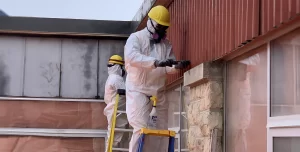
Workers inside containment wear full protective equipment including disposable coveralls, gloves, and respirators equipped with HEPA filters or supplied air systems. Before entering the work area, workers pass through a decontamination chamber that allows them to remove contaminated clothing and equipment without carrying fibers into clean spaces. The same decontamination procedures apply when exiting the work area.
Materials are thoroughly wetted before disturbance to suppress dust and fiber release. Wet removal methods dramatically reduce airborne fiber concentrations compared to dry removal. Workers use hand tools whenever possible, avoiding power tools that can generate significant amounts of dust. Removed materials are immediately placed in labeled, leak-tight containers—typically heavy-duty plastic bags or rigid containers designed for asbestos waste. Nothing leaves the containment area without proper packaging and decontamination.
Following removal, all surfaces within the work area are cleaned using HEPA-filtered vacuums and wet wiping methods. Visual inspection confirms that no visible debris remains. Air monitoring verifies conditions are safe and the space can be returned to service, including safe reopening of air conditioning ducting after negative air and HEPA-filtration systems have concluded. Clearance testing provides documented verification that the space is safe for reoccupancy and that subsequent renovation work can proceed without asbestos-related precautions.
Disposal Requirements and Documentation
Asbestos waste cannot be disposed of in ordinary landfills. The materials must be transported by licensed haulers to disposal facilities specifically permitted to accept asbestos-containing waste. These facilities have constructed cells designed to prevent fiber release and have monitoring programs to verify ongoing containment. Disposal fees for asbestos waste exceed fees for ordinary construction debris, reflecting the specialized handling and long-term containment requirements.
Documentation tracks asbestos waste from generation through disposal, a responsibility handled by certified asbestos abatement companies. Waste manifests identify the generator, the transporter, and the receiving facility. Each party signs the manifest to confirm proper handling at each stage. The generator—typically the abatement contractor—retains copies of completed manifests as proof that waste was properly disposed. This documentation trail protects property owners by demonstrating compliance with disposal requirements and may be requested by regulatory agencies during inspections or enforcement actions.
Improper disposal exposes property owners to liability, especially when relying on unqualified demolition contractors or uncertified operators. Property owners who hire unqualified contractors may discover that waste was illegally dumped rather than properly disposed of, creating additional liability and potential cleanup obligations. Verifying that contractors hold required licenses and use proper disposal facilities protects property owners from these consequences.

What Happens When Requirements Are Ignored
The asbestos NESHAP regulations impose strict liability on property owners, operators, and contractors involved in demolition and renovation activities. Strict liability means that violations result in penalties regardless of intent or knowledge. A property owner who genuinely did not know asbestos was present faces the same enforcement consequences as one who knowingly chose to skip inspection and proper removal, which may require professional asbestos abatement. Ignorance is not a defense. Delegating responsibility to a contractor is not a defense. The regulations assign responsibility to all parties involved in the work, including any interior demolition contractors who disturb materials containing asbestos.
Civil penalties for asbestos NESHAP violations can reach $50,000 or more per day of violation. A renovation project that proceeds for two weeks without proper inspection and notification could generate penalties in the hundreds of thousands of dollars. Criminal penalties apply to knowing violations, with potential imprisonment for individuals who willfully violate the regulations. Corporate officers and managers can face personal criminal liability for violations committed by their organizations.
Beyond regulatory penalties, improper asbestos handling creates enormous civil liability exposure. Workers who develop asbestos-related diseases can pursue claims against property owners, contractors, and others involved in their exposure. Mesothelioma cases routinely result in verdicts and settlements measured in millions of dollars. Building occupants exposed due to improper renovation work can pursue similar claims. Insurance policies typically exclude coverage for asbestos-related claims, particularly when proper procedures were not followed—leaving property owners personally responsible for judgments, settlements, and potentially requiring costly environmental remediation services to restore the building.
The practical consequences of improper handling extend beyond legal liability. Contaminated buildings may require extensive remediation that far exceeds original project costs. Renovation projects may be halted indefinitely while contamination is assessed and addressed. Properties may lose value or become difficult to sell when asbestos issues are discovered. The attempted savings from skipping proper procedures prove illusory when the true costs become apparent.
Protecting Your Project and Your Investment
Smart property owners build asbestos assessment into project planning from the very beginning. Before finalizing renovation budgets, before signing contracts with general contractors, before scheduling start dates—arrange professional inspection of areas where work will occur. If asbestos-containing materials are found, abatement costs become part of the project scope from the start rather than an unwelcome surprise that derails timelines and budgets after work has begun and may require a certified asbestos removal company.
The cost of professional inspection is minimal compared to total project costs and trivial compared to the costs of improper handling. Testing typically runs a few hundred to a few thousand dollars, depending on building size and the number of samples required. This investment provides certainty about what materials are present and what requirements apply. It protects property owners from enforcement actions. It protects workers from exposure. It protects projects from shutdown orders and remediation requirements.
When selecting contractors for renovation work, verify their understanding of asbestos requirements. Reputable general contractors know that inspections must occur before work begins. They will not pressure property owners to skip testing or proceed without clearance. They understand that their own workers face exposure if asbestos-containing materials are disturbed without proper precautions, and they take those risks seriously. Contractors who dismiss asbestos concerns, who claim that testing is unnecessary, or who offer to handle removal without proper certification create liability for everyone involved.
The broader context of Pennsylvania's asbestos crisis—including why so many older buildings contain these materials and what warning signs property owners should recognize—is explored in [Pennsylvania's Hidden Asbestos Crisis: Why Older Buildings in South Central PA Remain Dangerous]. Understanding that context helps property owners recognize when a professional assessment is warranted and why the regulations exist in the first place.

The Human Cost of Noncompliance
The regulations governing asbestos abatement exist because asbestos exposure kills people. This is not an abstraction or a theoretical risk. Forty thousand Americans die from asbestos-related diseases every year. Mesothelioma, the signature cancer caused by asbestos exposure, has a median survival time measured in months. Lung cancer risk increases substantially with asbestos exposure, particularly among smokers. Asbestosis, a progressive scarring of the lungs, causes increasing disability over years and decades.
These diseases have latency periods measured in decades. The worker who tears out asbestos-containing floor tiles without proper protection today will not develop symptoms for 20, 30, or 40 years. By then, the connection to a specific exposure may be difficult to establish. But the disease will be real, the suffering will be real, and the death will be real. The property owner who authorized the work, the contractor who performed it, and everyone else involved in the decision to skip proper procedures will bear moral responsibility for that outcome, even if legal responsibility cannot be established. This is also why certified asbestos abatement services providers exist, to prevent life-altering exposure.
The full scope of the ongoing death toll and why it has not declined despite decades of regulatory effort is examined in [Asbestos Still Kills 40,000 Americans Every Year: Why Pennsylvania Property Owners Must Act Now]. Understanding those numbers provides essential context for why compliance with abatement requirements matters and why cutting corners is never acceptable.
Partner with Kell Environmental for Asbestos Abatement
Kell Environmental provides certified asbestos abatement services throughout York, Lancaster, Berks, Dauphin, Cumberland, Adams, Lebanon, and Chester counties. From initial inspection through final clearance, our trained professionals ensure your renovation project proceeds safely and in full compliance with all applicable regulations. We understand the federal NESHAP requirements, the Pennsylvania DEP notification process, and the local considerations that affect projects throughout South Central Pennsylvania.
Our Services Include:
- Asbestos Abatement — Professional inspection, testing, containment, removal, and disposal by certified professionals for residential, commercial, and industrial properties
- Mold Remediation — Comprehensive environmental services for properties requiring treatment of multiple hazards
Planning a Renovation? Contact Kell Environmental before work begins. Professional inspection protects your project, your family, your workers, and your investment. The cost of compliance is minimal. The cost of noncompliance can be catastrophic.
Works Cited
"Asbestos-Containing Materials (ACM) and Demolition." U.S. Environmental Protection Agency, 13 June 2025, www.epa.gov/large-scale-residential-demolition/asbestos-containing-materials-acm-and-demolition. Accessed 22 Dec. 2025.
"Information for Owners and Managers of Buildings that Contain Asbestos." U.S. Environmental Protection Agency, 23 July 2025, www.epa.gov/asbestos/information-owners-and-managers-buildings-contain-asbestos. Accessed 22 Dec. 2025.
Related Articles
- [Asbestos Still Kills 40,000 Americans Every Year: Why Pennsylvania Property Owners Must Act Now]
- [Pennsylvania's Hidden Asbestos Crisis: Why Older Buildings in South Central PA Remain Dangerous]